

The Numbers Tell the Story
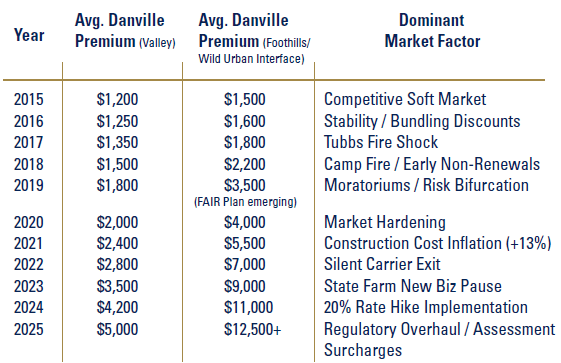
For a standard 2,500 square foot single-family home built in 1980, Danville insurance costs have moved like this over the past decade:
Valley floor properties have seen average annual premiums climb from roughly $1,200 in 2015 to approximately $5,000 in 2025. That is a meaningful increase, but the coverage remains available through traditional carriers for most homes.
Foothills and wildland-urban interface properties (particularly in the 94506 ZIP code) tell a very different story. Average premiums have surged from $1,500 in 2015 to over $12,500 in 2025. Many of these homeowners are now relying on a combination of the California FAIR Plan for fire coverage and a separate Difference-in-Conditions policy for liability and other perils, because traditional admitted carriers have stopped offering coverage in these areas. Some high-fire-risk properties are seeing quotes above $14,000 annually.
The key inflection points were the Tubbs Fire in 2017, the Camp Fire in 2018, and the wave of carrier exits and moratoriums that followed in 2019 and 2020. Since then, each year has added a new layer of cost: construction cost inflation, regulatory rate hike approvals, and assessment surcharges from the FAIR Plan itself.
Why This Is a Seller Problem, Not Just a Buyer Problem
Here is where most sellers get caught off guard. A buyer walks into your open house, gets emotionally attached, writes a strong offer, and has a pre-approval letter from their lender. Everything looks solid. Then two weeks into escrow, their lender requires proof of insurance. The buyer gets quotes. The numbers come back at $800 to $1,000 per month on top of their mortgage payment. Suddenly, their debt-to-income ratio no longer qualifies, or they simply decide the total cost of ownership is more than they want to take on. The deal falls apart.
You have now lost two to three weeks of market time. Your home shows as "back on market" in the MLS, which signals to every other buyer and agent that something went wrong. Your leverage has decreased, and the next offer is almost always lower.
This is not a hypothetical scenario. It is happening in transactions across the Tri-Valley right now.
How Strategic Sellers Are Getting Ahead of the Insurance Problem
The sellers who are navigating this successfully are not waiting for buyers to discover the problem. They are solving it before they list.
Step 1: Review Your Property Claims History Early
Your home's CLUE report (Comprehensive Loss Underwriting Exchange) contains every insurance claim filed on the property for the past seven years. Buyers and their insurers will pull this report during escrow. If there are prior claims for water damage, fire, or other issues, it can affect both the availability and cost of coverage for the next owner.
Reviewing this early gives you time to address any red flags. If a past claim was minor and fully resolved, having documentation ready can prevent it from becoming a negotiation issue or a reason for a carrier to decline coverage.
Step 2: Gather Preliminary Insurance Data Before You List
Work with an independent insurance broker (not a captive agent tied to one carrier) to get current market quotes for your property. This accomplishes two things. First, it gives you realistic data about what a buyer will face, which informs your pricing strategy. Second, if coverage is difficult to obtain or unusually expensive, you can proactively present solutions to buyers rather than letting them discover the problem on their own timeline.
For foothills properties where traditional carriers are not writing new policies, having a pre-assembled insurance package showing FAIR Plan plus DIC coverage options, with actual premium numbers, removes one of the biggest sources of buyer uncertainty. Uncertainty kills deals. Clarity keeps them together.
Step 3: Factor Insurance Into Your Buyer Qualification Strategy
Not every offer is equal, and the strength of a buyer goes beyond their mortgage pre-approval. In a market where insurance can add $800 to $1,000 per month to carrying costs, an agent who understands how to evaluate buyer qualification in the context of total ownership cost can help you avoid tying up your home with a buyer who technically cannot afford it once insurance is included.
This is especially important in Danville's higher price bands where buyers are already stretching on down payments and reserves. Identifying "thin" buyers before you accept their offer protects your timeline and your leverage.
The Bigger Picture
Insurance is now part of the same risk category as inspections and financing when it comes to transaction readiness. Sellers who treat it as an afterthought are exposing themselves to failed escrows, price reductions, and lost market positioning. Sellers who address it proactively are removing friction from the transaction and protecting their equity.
The market rarely forgives second chances. In a climate where only 25% of Danville homes sold over asking in January 2026 and average sold prices are declining year over year, every advantage matters.
This analysis is drawn from the February 2026 Danville Performance Report, which covers additional risks including misleading agent metrics, buyer agent compensation strategy, and the full January market snapshot. Schedule a complimentary Risk and Launch Audit to stress-test your selling strategy before you list.
***Note: Premium estimates are based on a standard 2,500 square foot single-family residence constructed in 1980 with dwelling coverage limits adjusted annually for inflation. Estimates for the Foothills and Wildland-Urban Interface (specifically ZIP code 94506) incorporate the combined cost of the California Fair Access to Insurance Requirements (FAIR) Plan for fire coverage and a Difference-in-Conditions (DIC) policy for liability and other perils, reflecting the market reality where traditional admitted carriers have largely ceased writing new business. The significant cost divergence observed in 2024 and 2025 reflects recent quotes for high-fire-risk properties, which can exceed $14,000 annually when admitted market options are unavailable. Base trends for 2015 through 2021 are derived from California Department of Insurance premium surveys and construction cost indices.***